

Five Ways to Calm Your Anxiety at Night
Nighttime anxiety is incredibly common, and you're not alone if your mind races the moment your head hits the pillow. During the day, tasks and distractions keep anxious thoughts at bay. But at night, there's nothing to compete with them. The quiet gives those worries room to grow.
For many adults, this becomes a frustrating cycle: you're exhausted, but your brain won't stop. The good news is that anxiety at night is manageable. With the right strategies, you can train your nervous system to settle down. Below you will find five approaches worth trying.
1. Try a Body Scan to Ground Yourself
When anxiety spikes at night, your mind is frequently racing ahead to worst-case scenarios. A body scan pulls your attention back to the present moment. This is a core acceptance and commitment therapy (ACT) technique called present-moment awareness.
Start at the top of your head and slowly move your attention downward. Notice sensations without judging them. Tension in your shoulders, warmth in your hands, the weight of your body against the mattress. You're not trying to fix anything. Simply observing what's happening in your body can interrupt anxious thought spirals.
2. Write Down What's On Your Mind
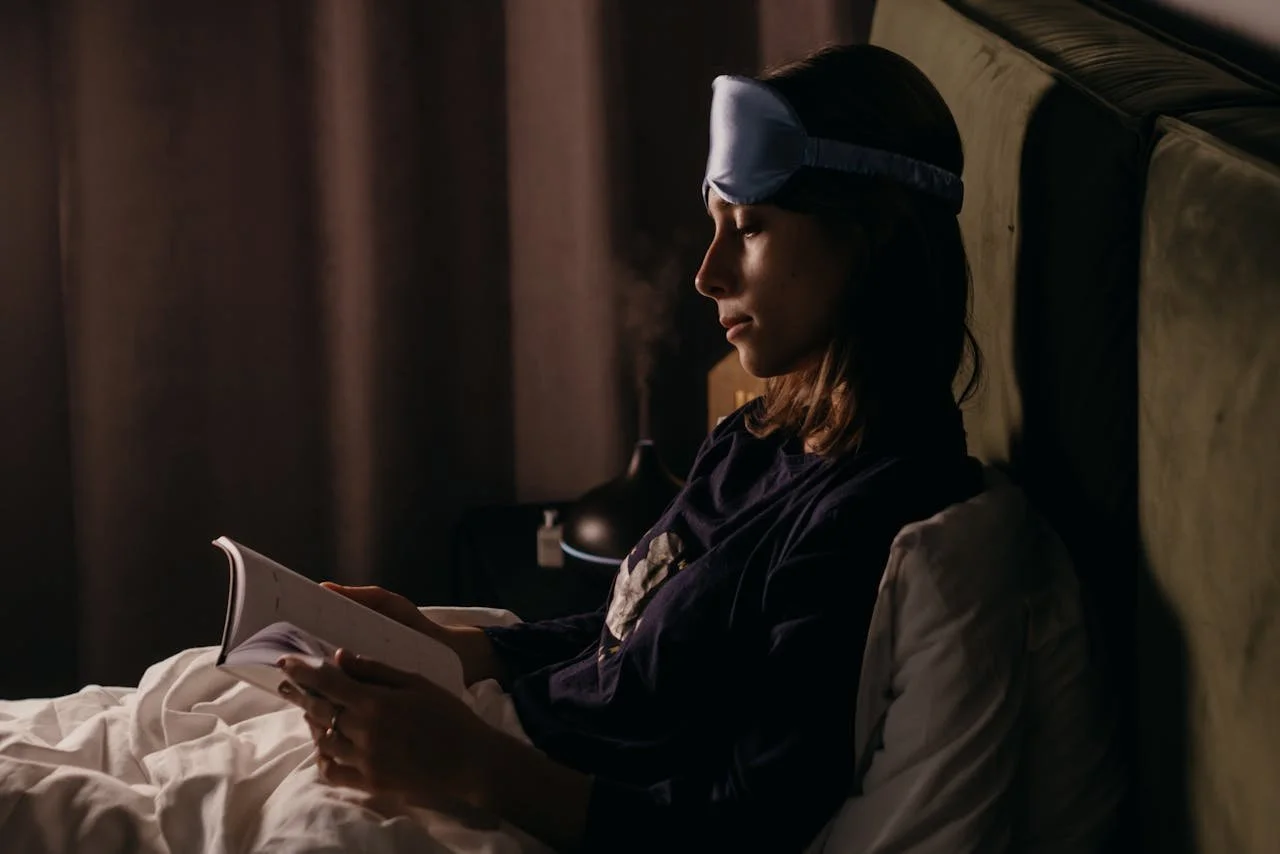
Anxiety loves to loop. The same worries circle back again and again, often because your brain is trying to "solve" something it can't resolve right now. Writing can break that loop.
Keep a notebook by your bed. Before sleep, spend five to ten minutes writing out whatever is on your mind. You don't need to find solutions. Getting thoughts out of your head and onto paper signals to your brain that they've been acknowledged. Research supports expressive writing as a tool for reducing pre-sleep cognitive arousal.
3. Use Controlled Breathing to Activate Your Calm Response
Your breath is one of the fastest ways to shift your nervous system out of fight-or-flight mode. Slow, deliberate breathing activates the parasympathetic nervous system, which is responsible for rest and recovery.
One effective method is the 4-7-8 technique. Inhale for four counts, hold for seven, and exhale for eight. The extended exhale is key. Slow exhalation signals safety to your nervous system. Even a few minutes of this practice can meaningfully reduce anxiety symptoms.
4. Challenge the Thoughts Keeping You Awake
Cognitive behavioral therapy (CBT) offers a practical tool for nighttime anxiety: cognitive restructuring. When an anxious thought shows up, try asking yourself a few questions. What's the evidence that this will happen? What's a more realistic outcome? Has this specific worry come true before?
Anxious thoughts often feel more credible at night than they actually are. Tiredness lowers your brain's ability to assess risk accurately. By examining your thoughts rather than accepting them as facts, you create distance between yourself and the anxiety. That distance makes it much easier to let go.
5. Create a Wind-Down Routine You Actually Stick To
Your brain responds well to predictability. A consistent pre-sleep routine signals that it's time to transition out of "problem-solving mode." This doesn't need to be elaborate.
Consider dimming lights an hour before bed. Avoid screens when possible, since blue light interferes with melatonin production. Light stretching, a warm shower, or a calming playlist can all work well. The goal is repetition. Over time, your body learns to associate these cues with rest, making it easier to fall asleep.
A Final Word
These strategies are effective tools, and they work even better with consistent practice. If nighttime anxiety is significantly disrupting your sleep or daily functioning, that's worth exploring with a professional.
Working with an anxiety counselor can help you understand the roots of your anxiety and build a personalized plan for managing it. Approaches like CBT and ACT have strong evidence behind them for exactly this kind of challenge. Reaching out is a sign of self-awareness, not weakness, and it can make a real difference.